

Pinion Angle Explained: Why It Matters for Your Lifted Truck (and How Our New Lift Blocks Fix It)
By Josh Smith, Apoc Industries • June 2026
If you’ve lifted your truck with rear lift blocks and started noticing vibrations, driveline noise, or weird handling, there’s a good chance pinion angle is the culprit. It’s one of the most overlooked aspects of lifting a vehicle — but it doesn’t have to be a headache.
In this guide, we’ll break down exactly what pinion angle is, why it goes wrong after a lift, and how our new reinforced compound taper lift blocks are designed to solve the problem right from the start.
What Is Pinion Angle?
The pinion angle is the angle of your rear differential’s pinion yoke (where the driveshaft connects) relative to the driveshaft and the transmission output shaft.
In a stock vehicle, everything is perfectly aligned so the U-joints rotate smoothly with minimal vibration. When you add height via lift blocks, the axle rotates and drops, changing these angles. If they’re off, your driveshaft works harder than it should.
Why Pinion Angle Causes Problems on Lifted Trucks
- Driveline Vibrations — Often shows up at specific speeds (40-70 mph) or under load.
- U-Joint & Transfer Case Wear — Excessive angles wear out parts faster.
- Axle Wrap & Wheel Hop — Especially noticeable during acceleration or towing.
- Driveshaft Extension Issues — The axle can shift rearward, over-extending the driveshaft.
Standard flat or single-taper lift blocks usually only address height — they ignore the factory leaf spring angle and don’t properly correct pinion angle. That’s where most problems start.
How Apoc’s Compound Taper Lift Blocks Solve It
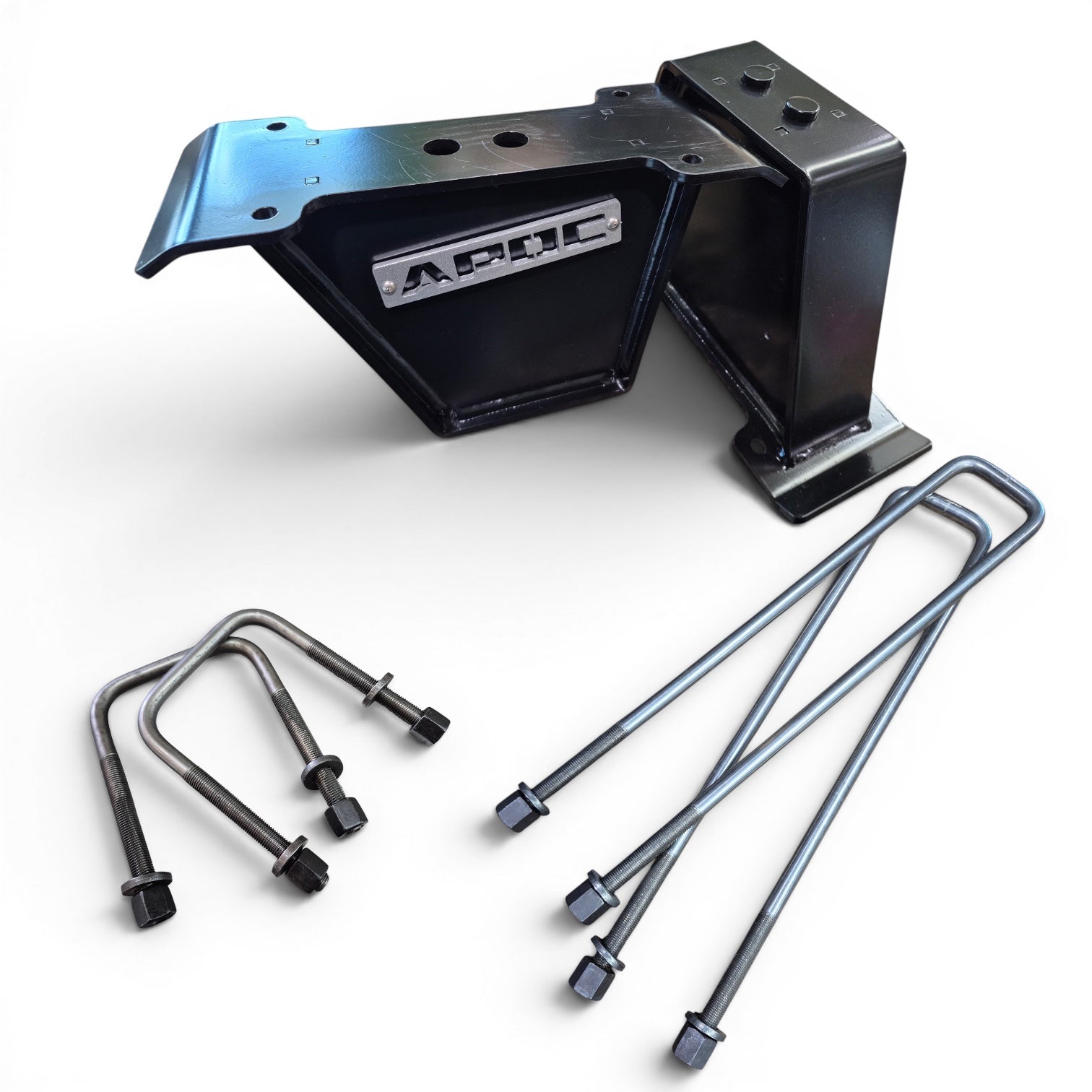
Our redesigned reinforced compound taper anti-wrap lift blocks are the first blocks engineered with two precise tapers in one solid piece:
- Top Taper: Matches your factory OEM leaf spring angle for perfect seating and even load distribution.
- Bottom Taper: Maintains optimal pinion angle at your chosen lift height (4", 5", 6", 7", or 8").
This keeps your axle centered in the wheel wells, protects your drivetrain, reduces axle wrap, and gives you a stable, vibration-free ride — even on taller lifts.
Shop Our Reinforced Compound Taper Lift Blocks →
How to Measure Your Pinion Angle (Simple DIY Guide)
- Park on a flat, level surface with the vehicle at normal ride height (full fuel, normal load).
- Use a digital angle finder (magnetic ones are cheap and accurate).
- Measure the angle of the driveshaft.
- Measure the angle of the pinion yoke or a flat spot on the differential (parallel to the pinion shaft).
- Compare to your transmission/transfer case output shaft angle.
Ideal setup for most single U-joint driveshafts: Pinion angle should be roughly equal but opposite to the transmission angle (within 1-2°). Many builders set the pinion 1-2° “nose down” statically to account for axle wind-up under acceleration.
Tips for a Smooth Lifted Truck
- Always re-check and adjust pinion angle after installing lift blocks.
- Replace U-bolts with longer ones matched to your new block height.
- For lifts above 6", add traction / ladder bars to further control axle wrap.
- If you still have vibes after proper setup, check driveshaft balance and U-joints.
Final Thoughts
Don’t let poor geometry ruin your lifted truck. Our new reinforced compound taper lift blocks are built by truck guys


Laisser un commentaire
Tous les commentaires sont modérés avant d'être publiés.
Ce site est protégé par hCaptcha, et la Politique de confidentialité et les Conditions de service de hCaptcha s’appliquent.